
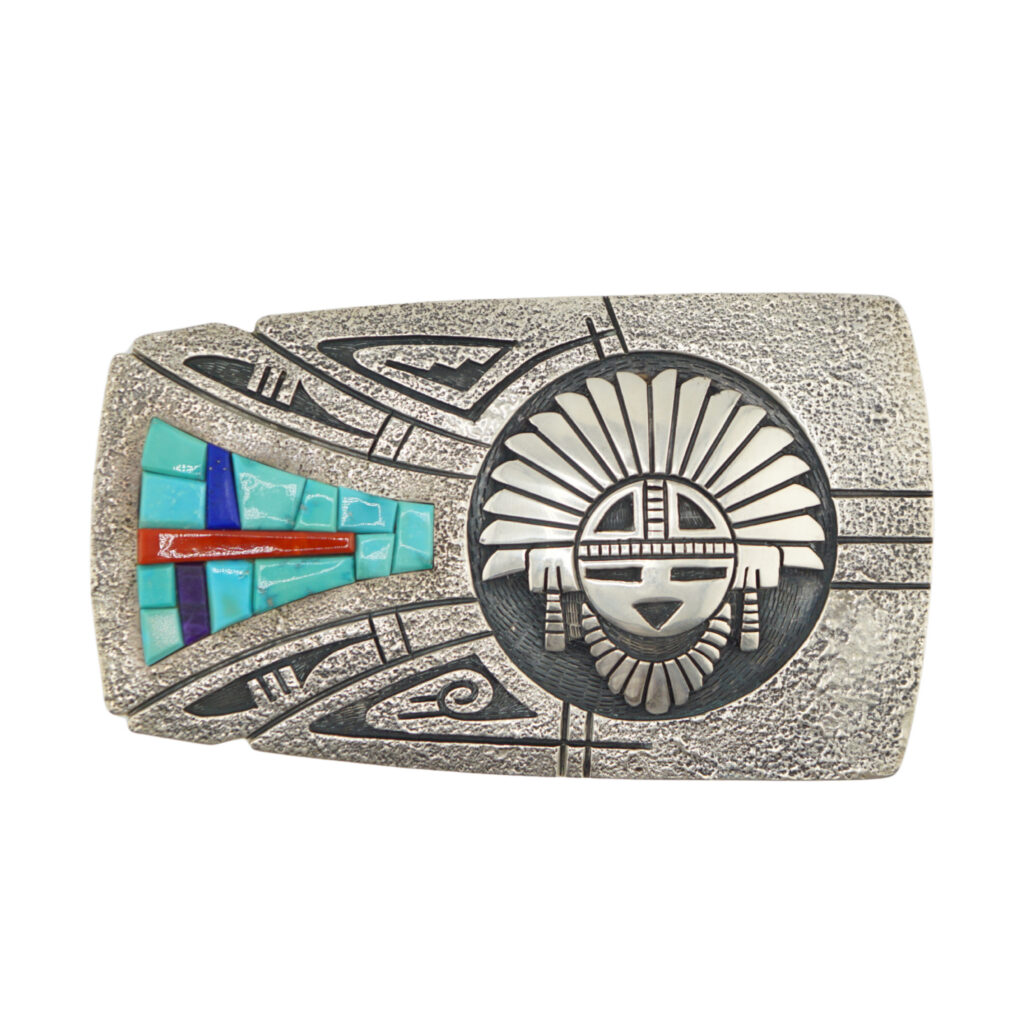
Hopi country sits high on the mesas of Northern Arizona, surrounded on all sides by the Navajo Nation. It’s beautiful country—but remote. In the early days of the Southwest trading era, tourists moving through by train or highway rarely made it all the way to Hopi. Gallup and the railroad towns saw much more traffic.
So when the Hopi first learned silversmithing in the late 1800s, jewelry wasn’t immediately a large commercial industry the way it later became in other parts of the Southwest. Much of the work was made for personal adornment, ceremonial use, or trade between families and communities.
Like many tribes in the Southwest, the Hopi learned silverwork from neighboring Native artists. Early Hopi jewelry likely resembled the Navajo-style silverwork common during that period—heavy silver pieces often centered around turquoise.
But over time, Hopi artists developed something entirely their own.
And today, once you learn to recognize it, Hopi jewelry stands apart immediately.
When most people think about Native American jewelry, they think about turquoise. Large stones. Bright colors. Cluster work.
Hopi jewelry often moves in a different direction.
Traditional Hopi work is usually about the silver itself.
The technique most associated with Hopi jewelry is called overlay. Instead of building a piece around stones, artists create designs by layering two sheets of silver together. The bottom sheet is darkened, while the top layer is carefully cut by hand with symbols and designs. When the two layers are joined, the contrast creates bold imagery and depth.
It’s clean. Graphic. Timeless.
And unlike many styles of Navajo and Zuni jewelry, a large amount of traditional Hopi work contains no stones at all.
That simplicity is part of what makes it powerful.
The Hopi have lived in the Southwest for centuries, and much of their artistic language comes directly from the land around them.
If you visit the mesas, you’ll see ancient petroglyphs carved into rock walls. You’ll find symbols carried through generations in pottery, weaving, basketry, and ceremonial life. Those same symbols eventually made their way into silverwork.
Many Hopi jewelry designs center around themes tied to farming, migration, spirituality, and clan identity.
Some common themes include:
Unlike decorative trends that come and go, these symbols carry meaning that stretches back hundreds—sometimes thousands—of years.
That’s part of why Hopi jewelry feels different when you hold it.
One of the easiest ways to begin identifying Hopi jewelry is by studying hallmarks.
Many Navajo and Zuni artists use initials or full names stamped into silver. Hopi artists often take a different approach.
Because symbolism plays such a large role in Hopi culture, many silversmiths use symbolic hallmarks instead of traditional signatures. You’ll often see:
Even when initials are used, they’re often designed in a way that feels more artistic and integrated into the piece itself.
Older Hopi jewelry may also carry guild marks from organizations like the Hopi Silvercraft Cooperative Guild, which helped promote Hopi silverwork during the mid-1900s. These guild hallmarks can be helpful when researching vintage pieces.
One thing that can confuse newer collectors is that overlay techniques eventually spread beyond Hopi artists.
Some Navajo silversmiths adopted overlay into their own work and developed beautiful styles of their own. In the Southwest, you’ll sometimes hear collectors refer to this crossover style as “Navahopi.”
That doesn’t automatically mean imitation.
Native American art has always evolved through trade, influence, and innovation between tribes and artists. Some Navajo overlay work is highly respected and entirely original.
At the same time, Hopi jewelry tends to command strong prices because the Hopi population is much smaller, and there are fewer silversmiths producing work. That smaller supply has occasionally led others to imitate Hopi styles for the market.
That’s why learning symbols, hallmarks, and construction techniques matters.
The more you study the work, the easier it becomes to recognize the difference between jewelry inspired by Hopi design—and jewelry deeply rooted in Hopi tradition.
Around Gallup and the Four Corners, Native American jewelry isn’t treated like a trend. People here grow up around it. Collectors study it for decades. Artists pass techniques down through families.
Hopi jewelry is part of that larger story.
It reflects a culture tied closely to the mesas, the land, and generations of tradition. And while styles continue to evolve, the strongest Hopi pieces still carry something unmistakable with them:
Patience. Precision. And identity.
That’s what people continue to respond to—whether they’re collectors, wholesalers, or someone buying their very first piece.